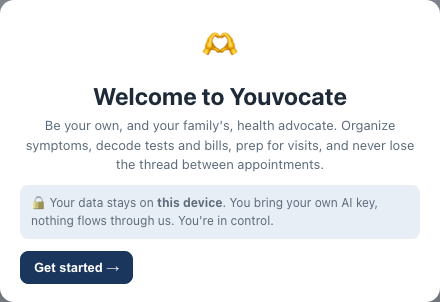
The first time Youvocate opens, the whole promise is one card: be your own, and your family’s, health advocate, and your record stays on this device.
The intro leads with the privacy pledge, not a feature tour. Trust is the first screen a user sees.
Youvocate.me is a private health app for you and your whole family, on your desktop and your phone. It gathers your symptoms, records, test results, and bills into one clear case, decodes what they mean, catches billing errors, and walks you into every appointment with a clinician-ready brief you can hand over or export.
Your case never leaves your device except to your own AI. No account, no login, no cloud. Youvocate runs on your machine and your record stays there. When you ask a question, your case goes to your AI model with your key; nothing passes through a Youvocate server, because there is not one. No trackers, no telemetry, no ads.
Health happens between the appointments, in the waiting and the worry: the dropped result, the bill no one can read, the symptom you cannot name, the thread lost from one visit to the next. Youvocate holds the thread. It never diagnoses and never replaces your clinician. It makes you ready.
Safety first, always. Red flags escalate and cannot be overridden. Every claim carries a source. Nothing is a diagnosis.
Built for a million moms and the families they carry, kids, partners, aging parents, and for anyone facing the normal stuff or the long diagnostic odyssey. Less wait. Less worry.
Meet the Joneses. One family, every way a life meets the health system, from a routine blood test to an estate. Watch the product work.
The first time Youvocate opens, the whole promise is one card: be your own, and your family’s, health advocate, and your record stays on this device.
The intro leads with the privacy pledge, not a feature tour. Trust is the first screen a user sees.

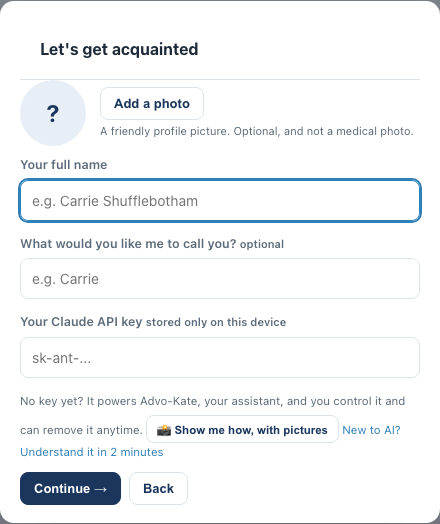
Name, what to call you, and your own AI key, stored only on this device. A “show me how, with pictures” guide sits one tap under the key.
Onboarding asks the minimum, and every field says where the data lives. The key is theirs to add or remove.

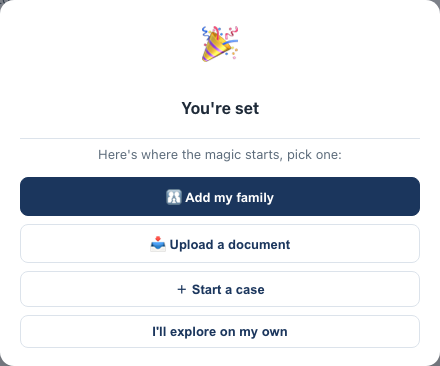
Then it hands the user a door: add the family, upload a document, start a case, or just explore.
The guide ends by pointing at a first move, four ways in, never dumping them onto an empty dashboard.

Every family has a song in it, the bright years and the hard ones alike. Meet the Joneses, from a routine blood test to an estate, and let it play from the top.
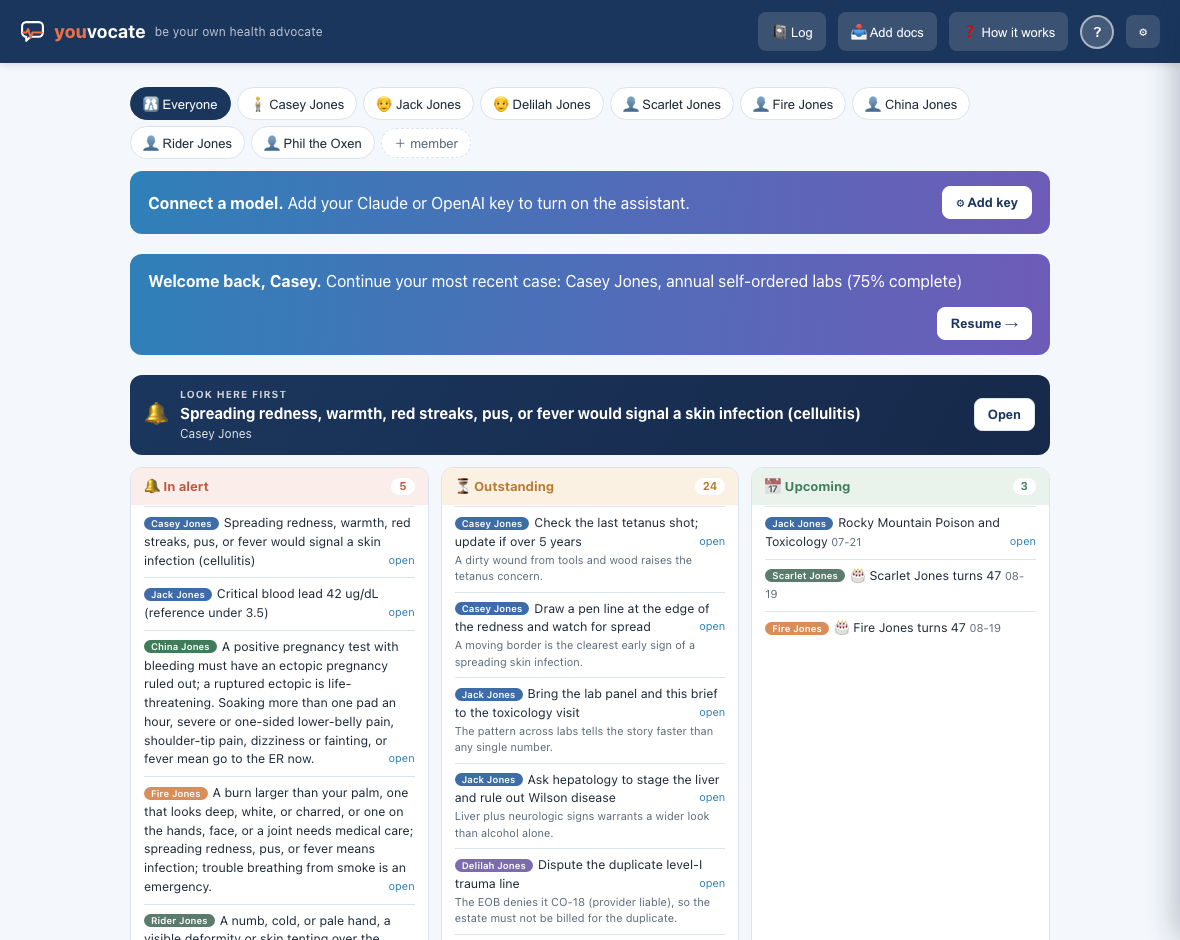
The household holds everyone: the living, the lost, and even the ox. Each name owns its own alarms.

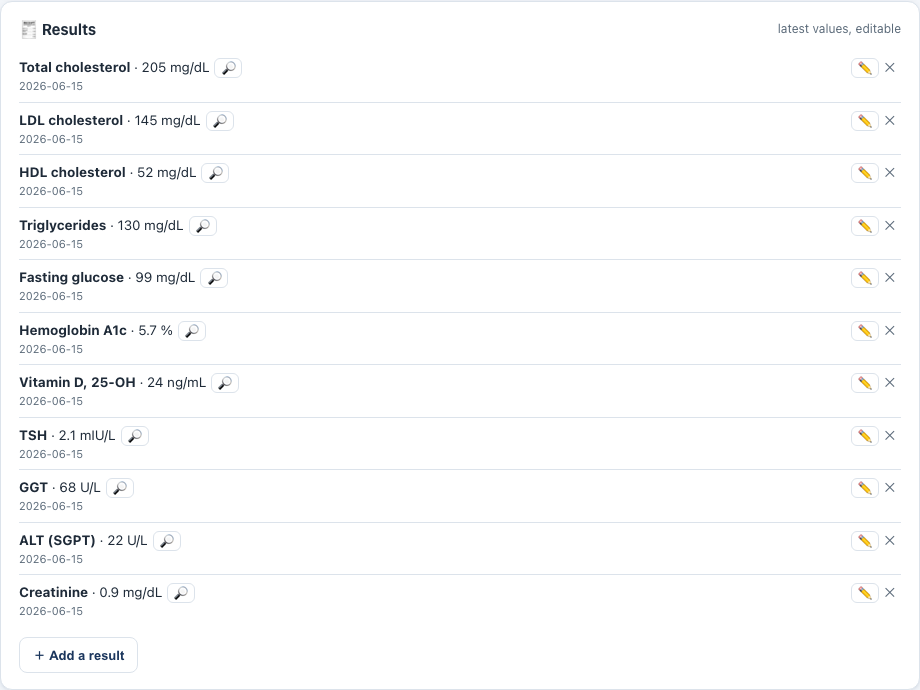
Casey orders a basic panel himself every year and pays cash, no visit. This year a few numbers moved.
A case can START from routine self-ordered labs. No symptoms, no bills, just tracking.

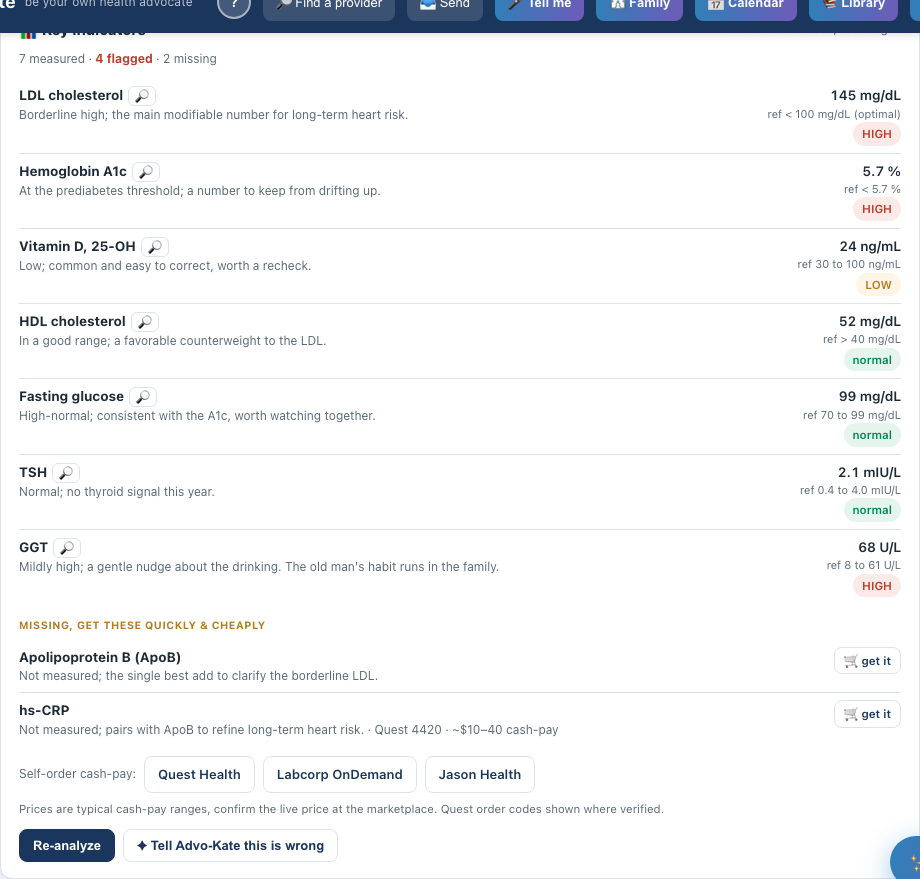
Advo-Kate pulls the numbers that matter, flags the movers, and lists what is missing and cheap to add.
Indicators is Advo-Kate acting on real values, not guessing. It also names self-orderable gaps (ApoB, hs-CRP).

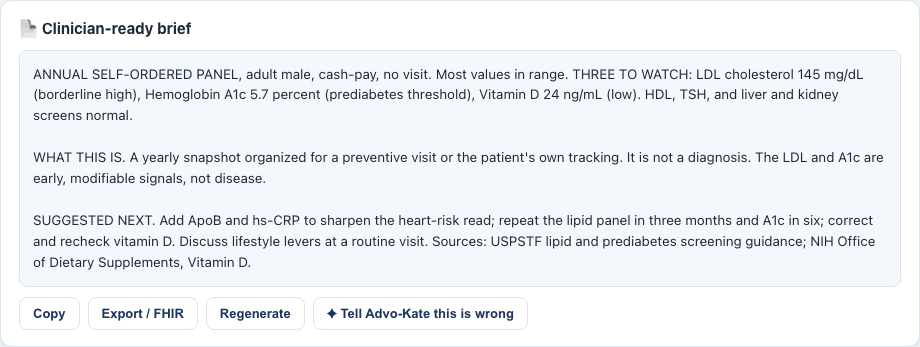
Even a wellness snapshot assembles into a portable brief for a preventive visit.
The Brief is the hero artifact in every mode, framed as education, never a diagnosis.

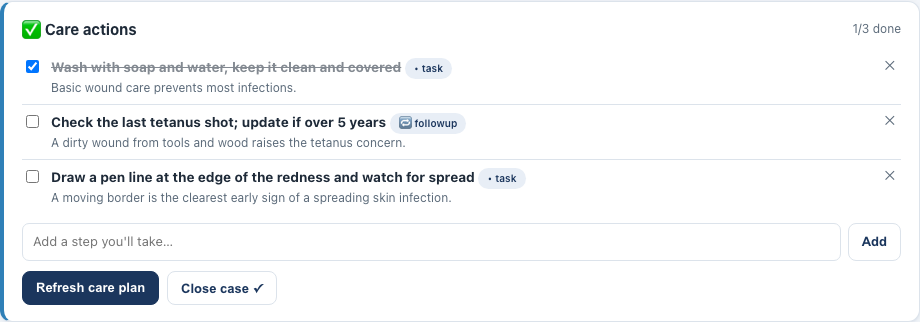
Casey cut hickory to fire the still and tore up his palm. Sore, a little pink. When does redness mean go in?
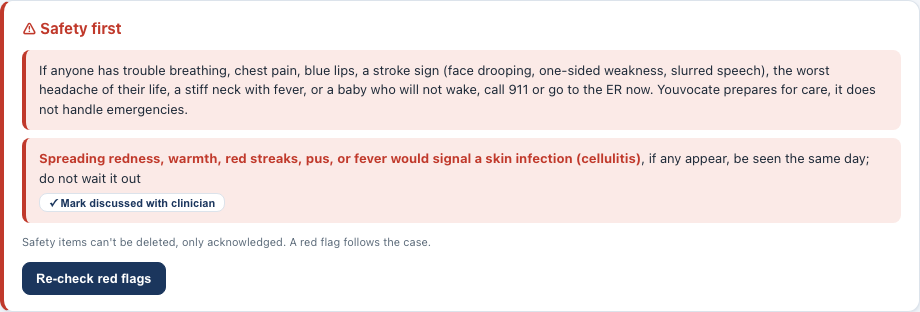
Safety-first even for a scrape: the app teaches the exact signs of a spreading infection, so worry has an edge to check against.

Wash and cover, check the tetanus clock, draw a pen line at the redness and watch it.
The reduce-worry mode is simple care steps + a watch, no labs or specialists. Not every function belongs in every case.

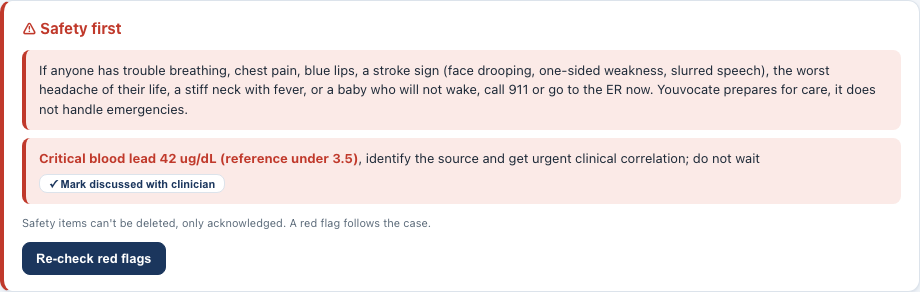
Decades of home spirits through a lead-jointed still. One panel, one screaming number: blood lead 42.
Safety is pinned to the top of the case and cannot be pushed down. A red flag follows the case.

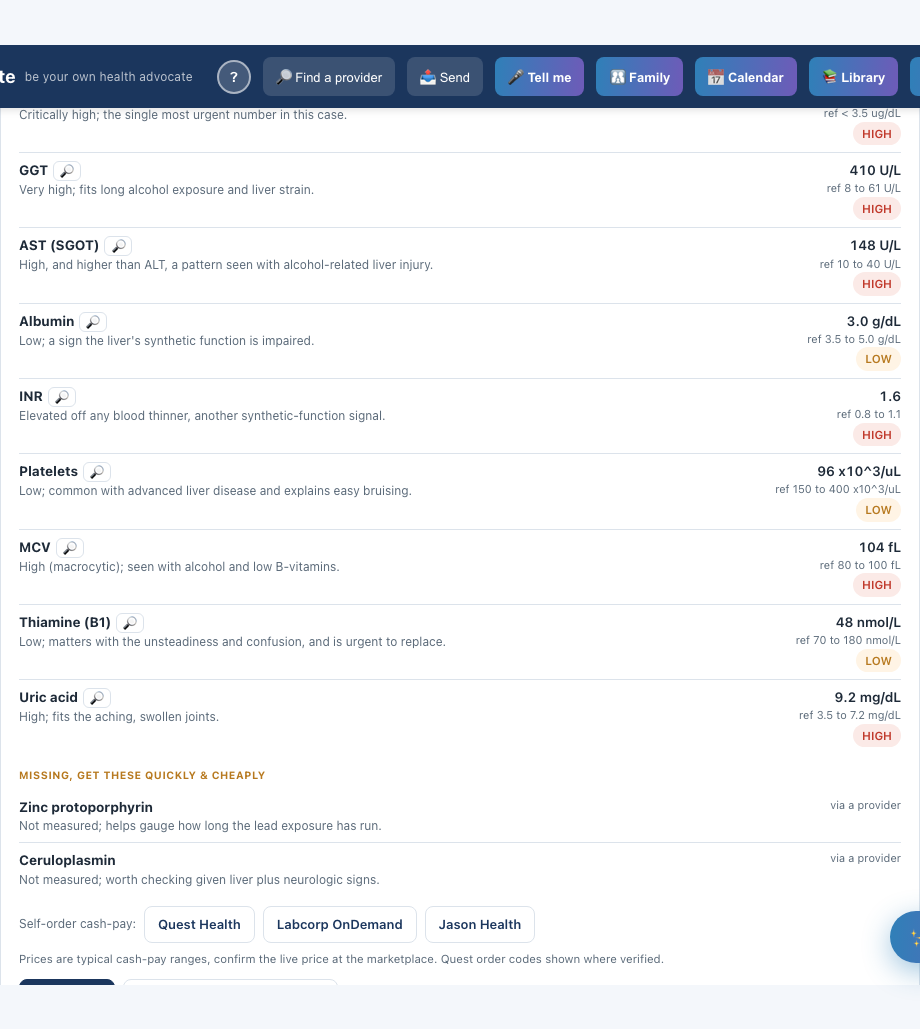
Lead, GGT, low albumin, high INR, low platelets, macrocytosis, low thiamine, high urate. One house.
Indicators holds the whole pattern together so a person sees what a scattered chart hides.

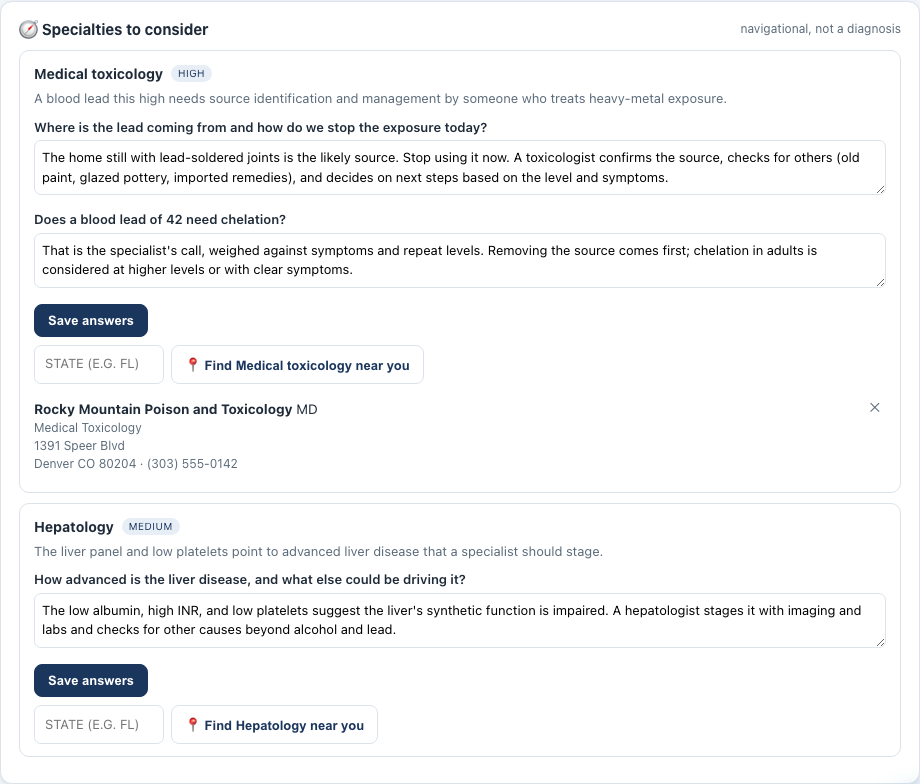
Toxicology for the lead, hepatology for the liver, each with the questions to ask, answered, and a real provider nearby.
Specialties is navigational, never a diagnosis. Advo-Kate drills the questions; the NPI registry finds the doctor.

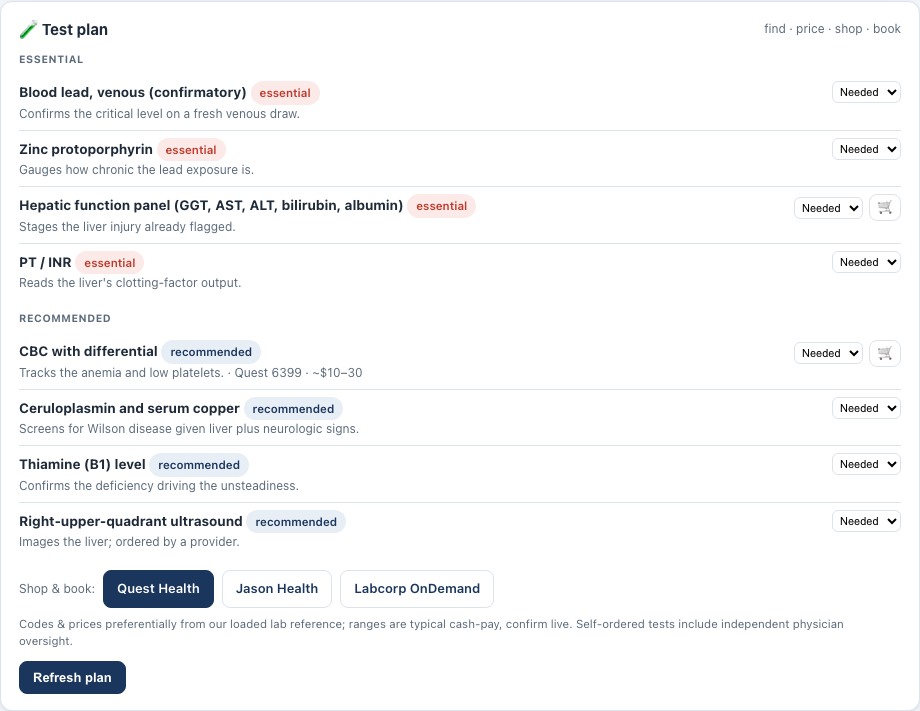
Confirmatory lead, zinc protoporphyrin, liver staging, a Wilson screen, thiamine, an ultrasound. Judged for THIS case.
The test plan marks what is essential vs optional and what the patient already has.

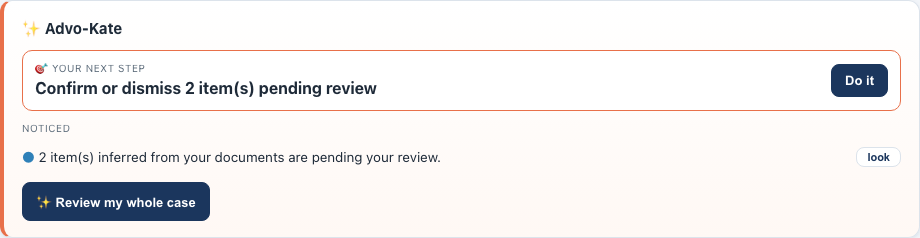
Advo-Kate reads the computed state and nudges the next best move, no key needed for the panel itself.
Advo-Kate is shown where she genuinely acts: her alerts are a deterministic scan, never blind chat.

A toxicology consult is on the calendar, already prepped with the questions and what to bring.
A prepped visit turns the whole case into questions in hand.

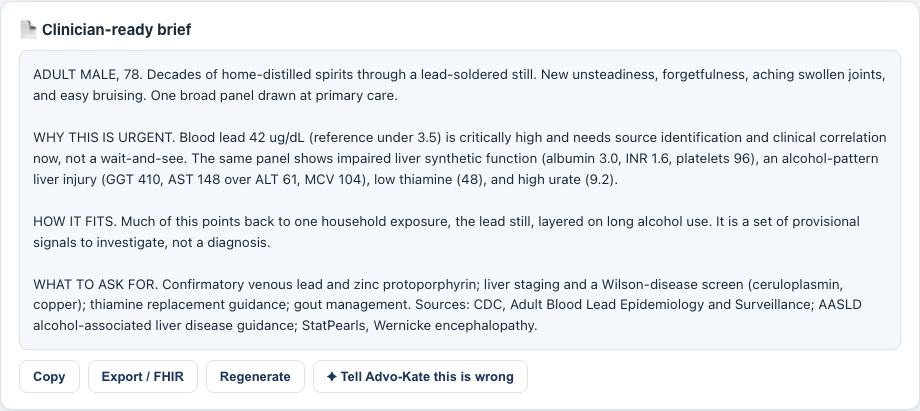
The one-page brief a doctor can act on: the lead, the liver pattern, what to ask for, and the sources.
This is the export that walks into the visit. It carries citations and stays non-diagnostic.

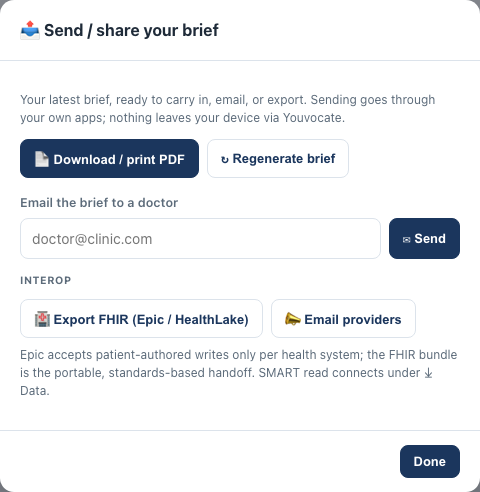
The finished brief leaves the way the visit needs it: a FHIR R4 bundle for Epic or a hospital data lake, a direct email to the doctor, or an outreach plan to a clinic. This is the most useful case leaving the family’s hands in a form a provider can actually ingest.
The hero artifact is portable and standards-based. Export is FHIR R4; sending runs through the user’s own mail and apps, never through Youvocate.

The roof gave way under the snow in Bigfoot County. Three days in intensive care, then gone. The bills came to her estate.
Estate mode: the app stops offering live care, keeps the record, and shifts to the paperwork with dignity.

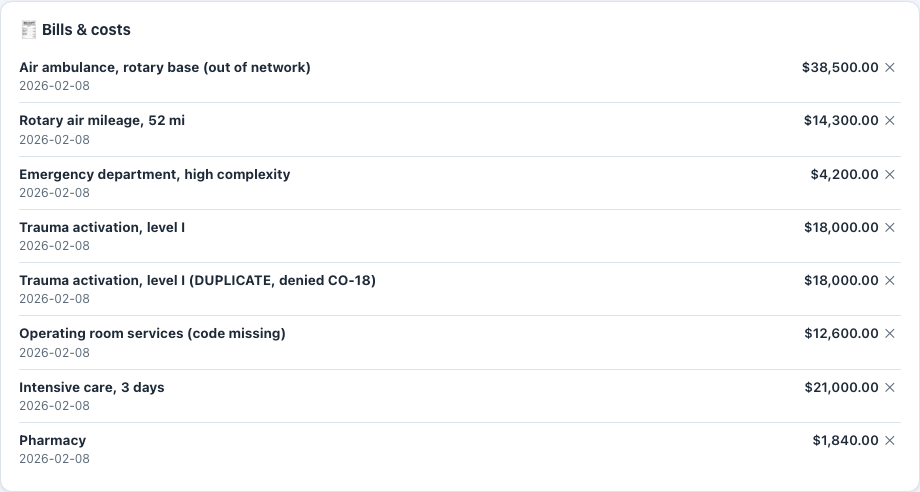
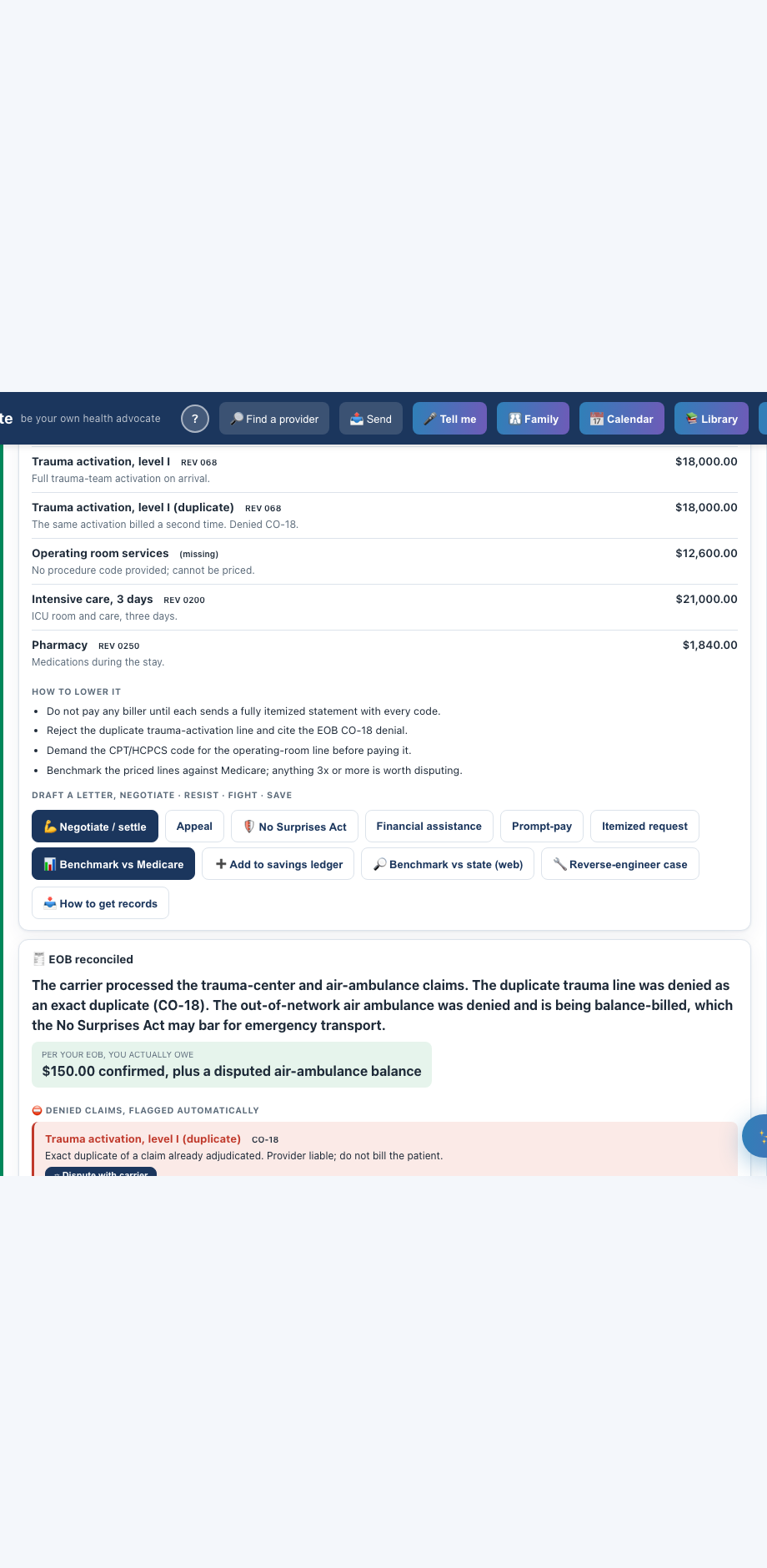
Air ambulance $38,500, mileage $14,300, a level-I trauma activation billed twice, an OR line with no code. Every line is almost its own case.
Money lives at the end of the case, itemized, so it never crowds out the person.

Advo-Kate decodes each line: the duplicate denied CO-18 (provider owes it, not the estate), the un-coded OR charge to reject, $30,600 to save.
This is Advo-Kate genuinely useful in the estate: bill review, benchmark, and ready-to-send letters.

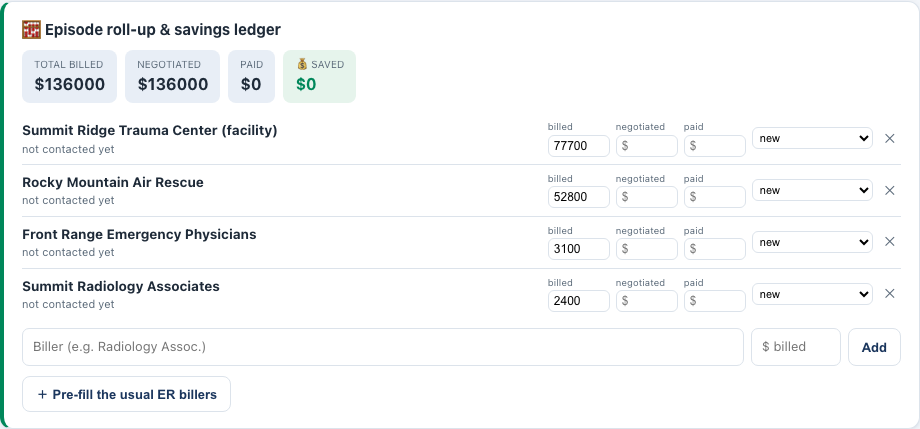
Every separate biller from one stay, tracked billed to negotiated to paid, so the savings add up in one place.
An ER or hospital stay fans out into many bills; the ledger rounds them all up.

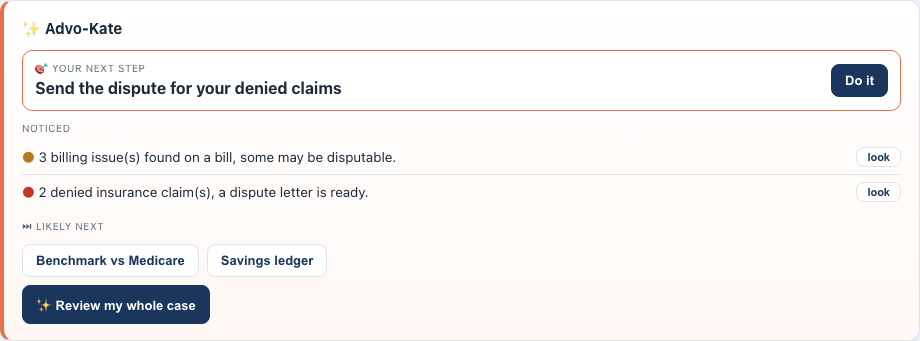
Advo-Kate stays on the case, but only for the fight that fits: the billing issues and the denied claim, not clinical care.
Estate mode suppresses her clinical nudges and keeps her billing help. She is scoped, not silenced.

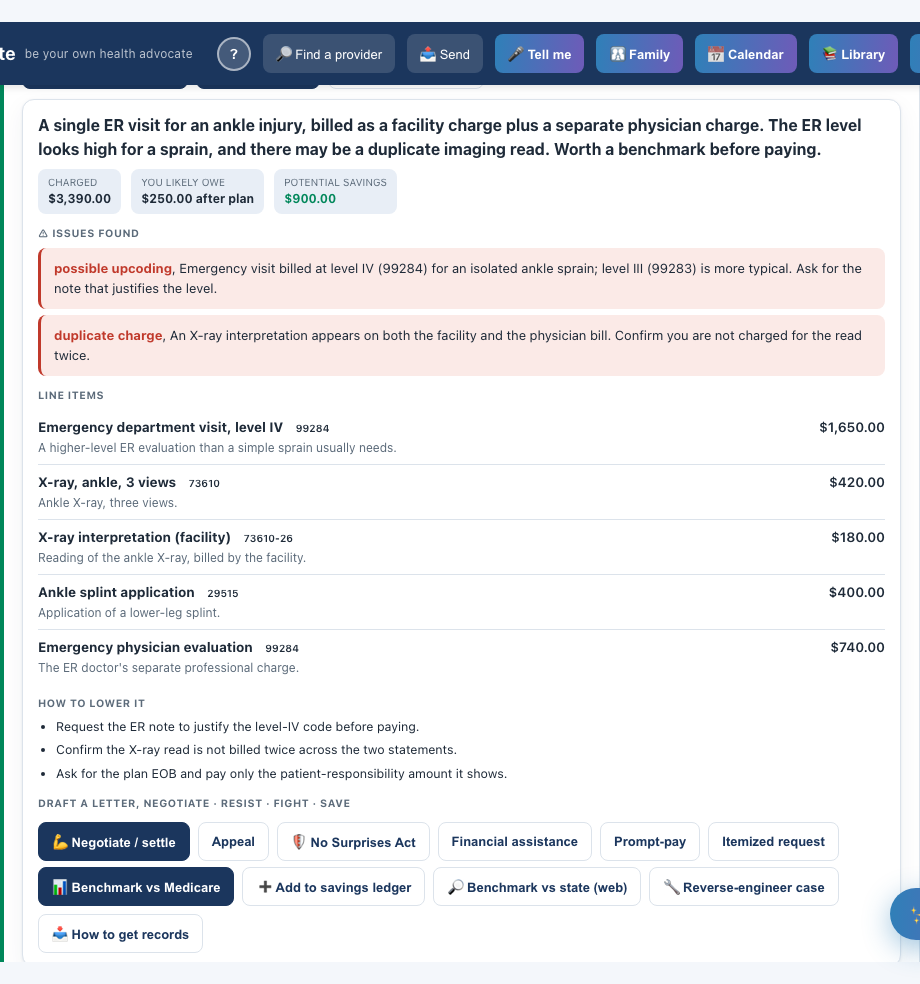
An old ER bill for a rolled ankle, billed at a high level with a possible double-charged X-ray read. Just reconciling the money.
Some cases are ONLY bills. You start from the statement and never enter a symptom.

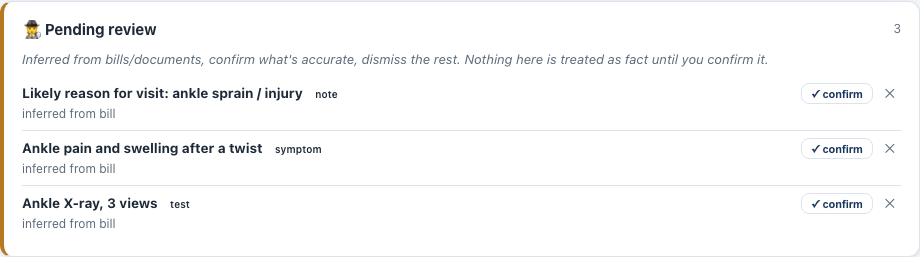
The clinical detail here was inferred from the bill itself, an ankle sprain, an X-ray, and left as pending until Casey confirms it.
Reverse-engineering a case from a bill produces inferences, never facts. Nothing is treated as true until confirmed.

China and her partner are trying for a baby. A positive test, then four to five days of heavy bleeding. Likely an early loss, but the first job is not the loss.
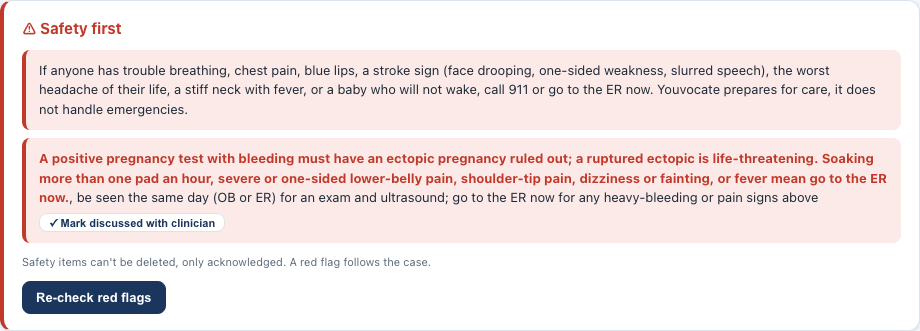
A positive test with bleeding is treated as a possible ectopic until proven otherwise. Safety leads: rule out the life-threat, know the ER signs, before anything else.

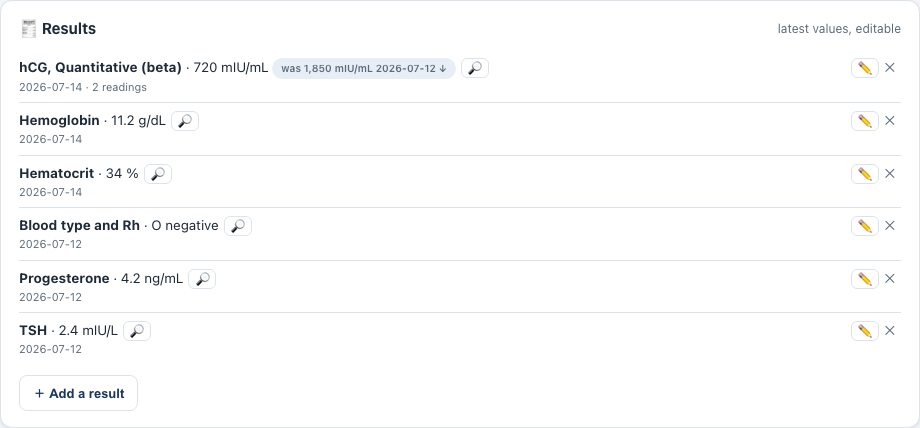
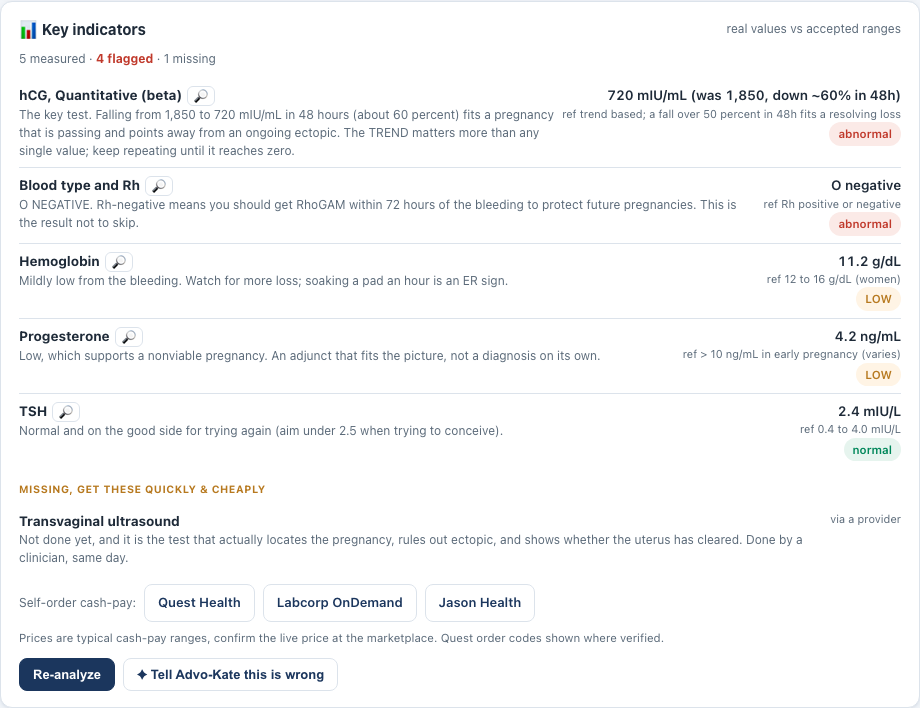
She got the labs herself right away. hCG 1,850, then 720 two days later, down about 60 percent. Hemoglobin mildly low. Blood type O negative.
This is what the tests to get NOW look like when they come back. The hCG TREND, not one value, is the signal, and the app shows the fall.

Advo-Kate reads them: the falling hCG points away from an ongoing ectopic, the low progesterone fits a nonviable pregnancy, and O-negative means RhoGAM, the result not to skip.
Indicators turns raw numbers into what they mean and what to do, and names the one test still missing: the ultrasound that only a clinician can do.

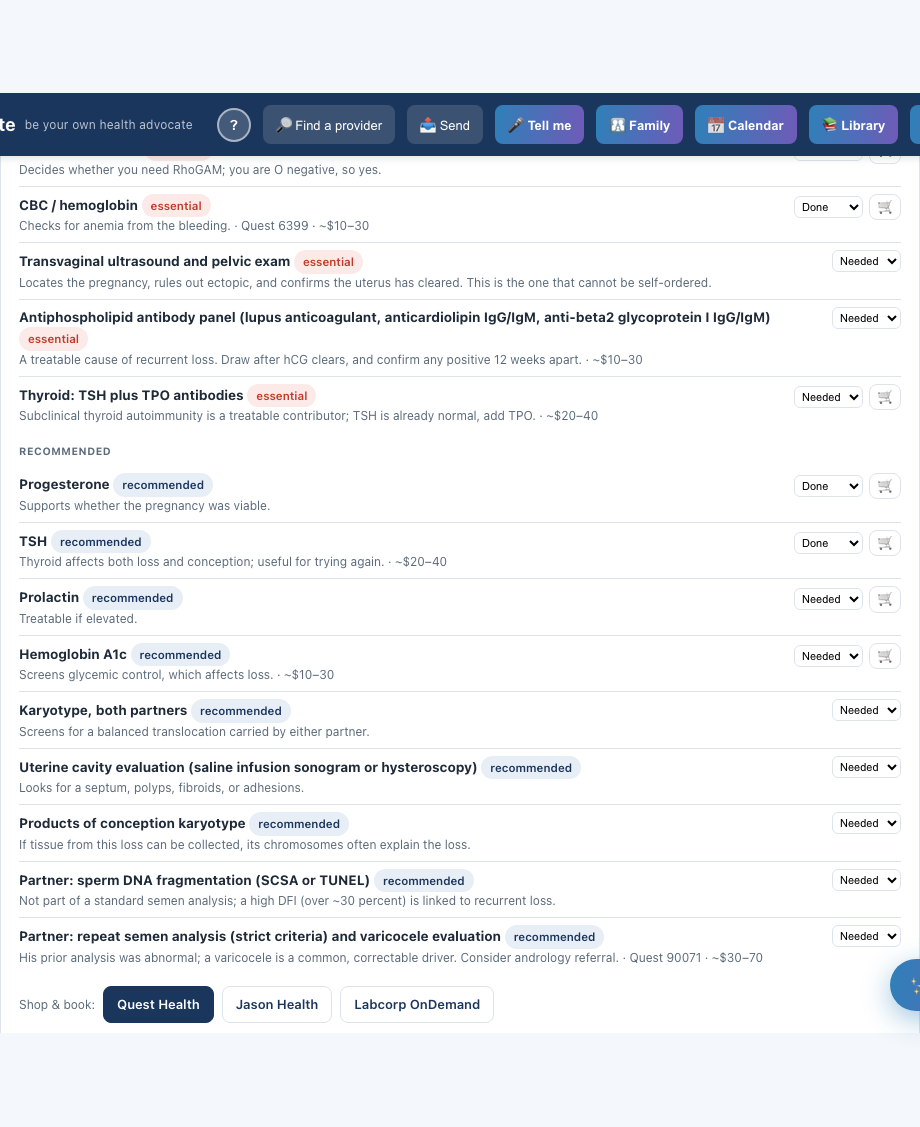
What is done (hCG serial, blood type, CBC, progesterone, TSH) and what is not: the transvaginal ultrasound, the one that actually rules out ectopic.
The plan is honest about the line between what you can self-order at Quest and what needs a clinician. Labs do not replace the visit.

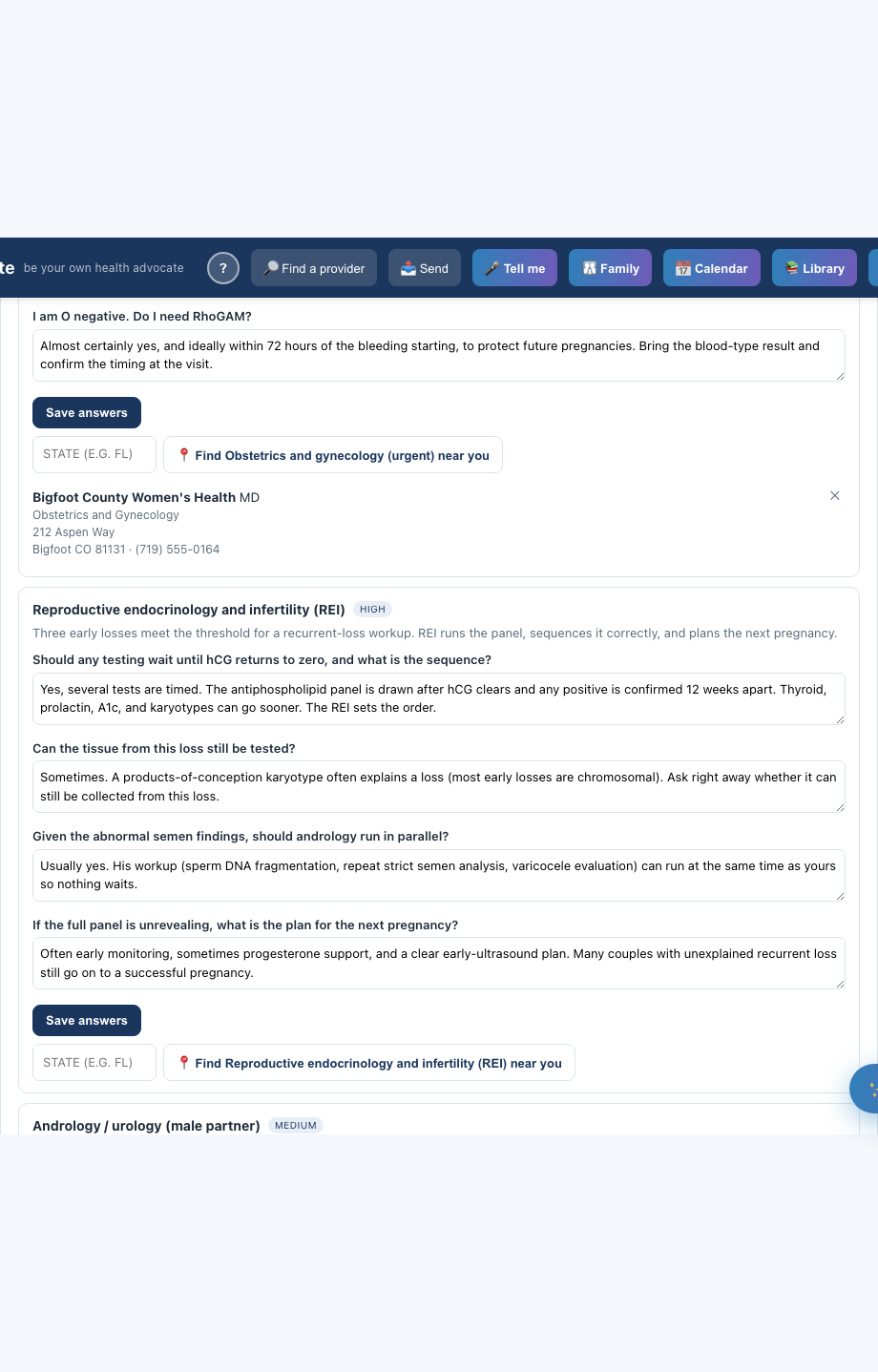
OB/GYN, urgent, with the questions answered in advance: is it ectopic, was the loss complete, do I need RhoGAM. A real clinic attached.
The scary questions get named and answered so the visit starts from understanding, not fear. Reproductive endocrinology is there for trying again.

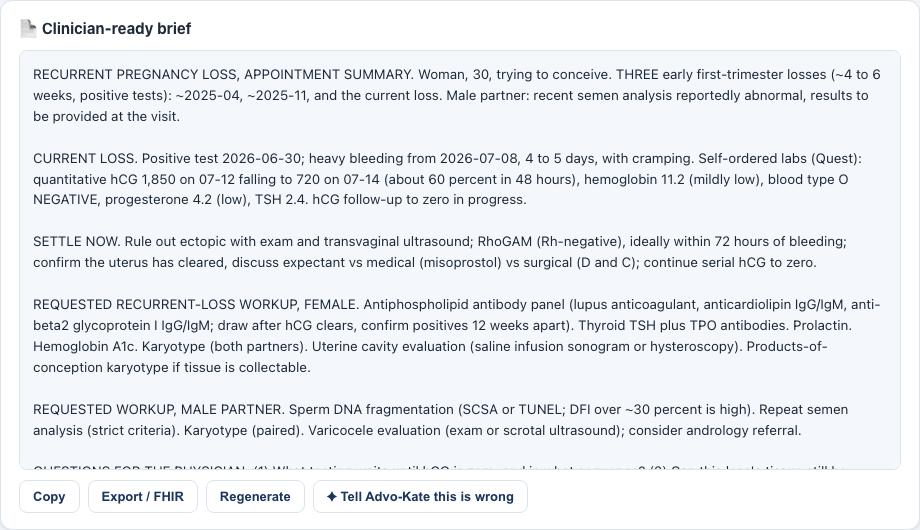
One page for the OB visit: the timeline, the labs already back, the ectopic rule-out, the RhoGAM within 72 hours, and the management choice, all sourced.
She walks in organized, with the trend and the Rh status that change what happens, and it never states a diagnosis.

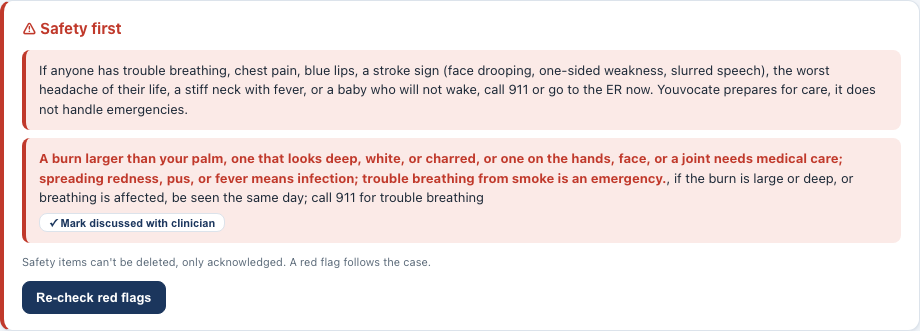
Fire caught his forearm on the hot still and has a smoky cough. A palm-sized blistered burn.
The app draws the line between home care and go-in: burn size and depth, the joints and face, and breathing trouble from smoke as an emergency.

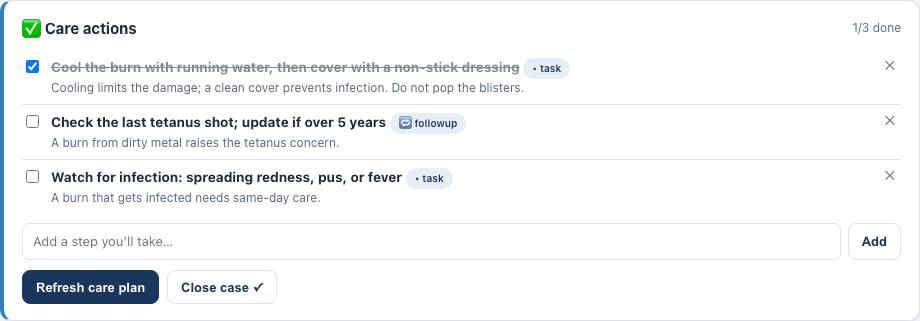
Cool it under water, cover with a non-stick dressing, do not pop the blisters, check the tetanus clock, watch for infection.
Simple, correct first aid plus a watch. Reduce-worry mode again, a different injury than the hickory cut.

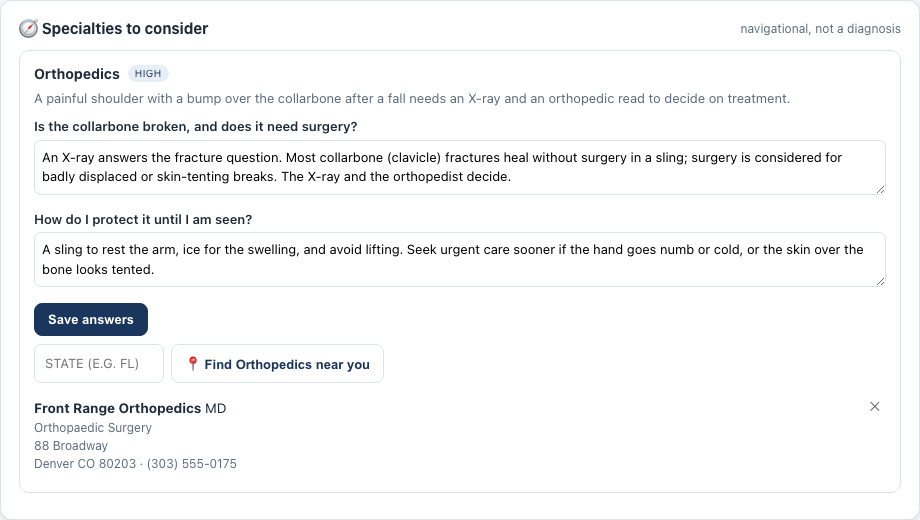
Rider came off a green horse onto his shoulder, with a bump over the collarbone. Orthopedics, with the fracture and surgery questions answered.
A focused injury case: the specialty is orthopedics, and the questions about a clavicle fracture are answered before the visit.

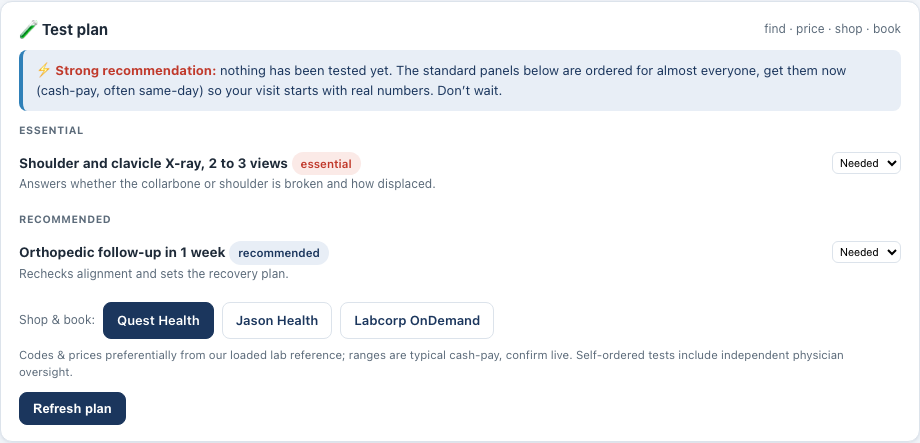
An X-ray answers the fracture question, then an orthopedic follow-up. Imaging is provider-ordered, not something to self-order.
Different mode than labs: the key test here is imaging, which the plan marks as clinician-ordered.

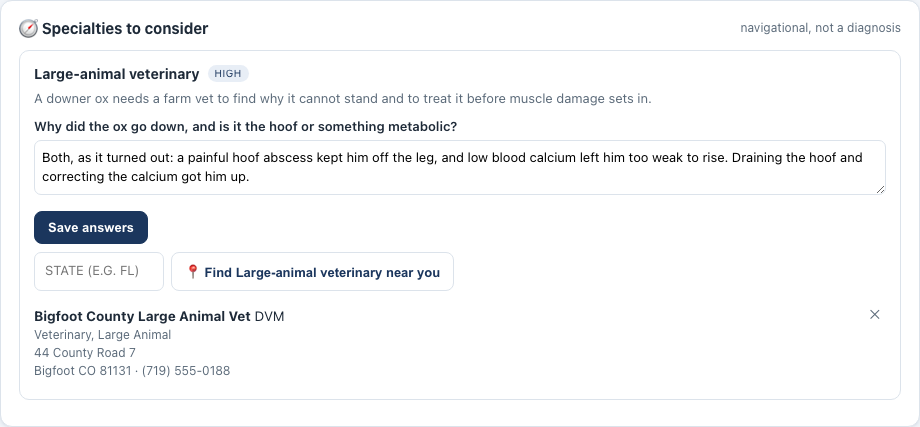
Even the ox gets a case. Phil went down in the field: a hoof abscess and low blood calcium.
The same case machinery serves the whole household, even the ox. Specialty here is the large-animal vet.

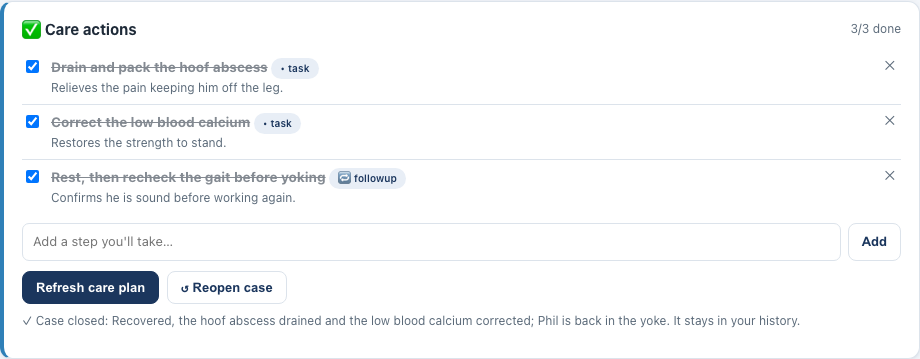
Hoof drained, calcium corrected, gait rechecked. Phil is up and back to the yoke. The case is closed, recovered.
The demo ends on a cure: a closed case with a resolution, the counterweight to Delilah. Cases finish, not just accumulate.

Every family meets the health system some way: a routine test, a result that scares you, a bill no one can read, a long road to an answer, an ending to settle. The Joneses are made up. What happens to them is not.
Youvocate holds the thread so no one carries it alone. It never diagnoses and never replaces your clinician. Safety first, always. Your record stays on your device. It just makes you ready, so every family keeps moving forward.
And we are all getting on.
To the moms and families who test this, and live it. And to the songwriters whose story became our map, with gratitude.
Brown-Eyed Women. Written by Robert Hunter and Jerry Garcia. Performed by the Grateful Dead, live at Barton Hall, Cornell University, May 8, 1977. Source.